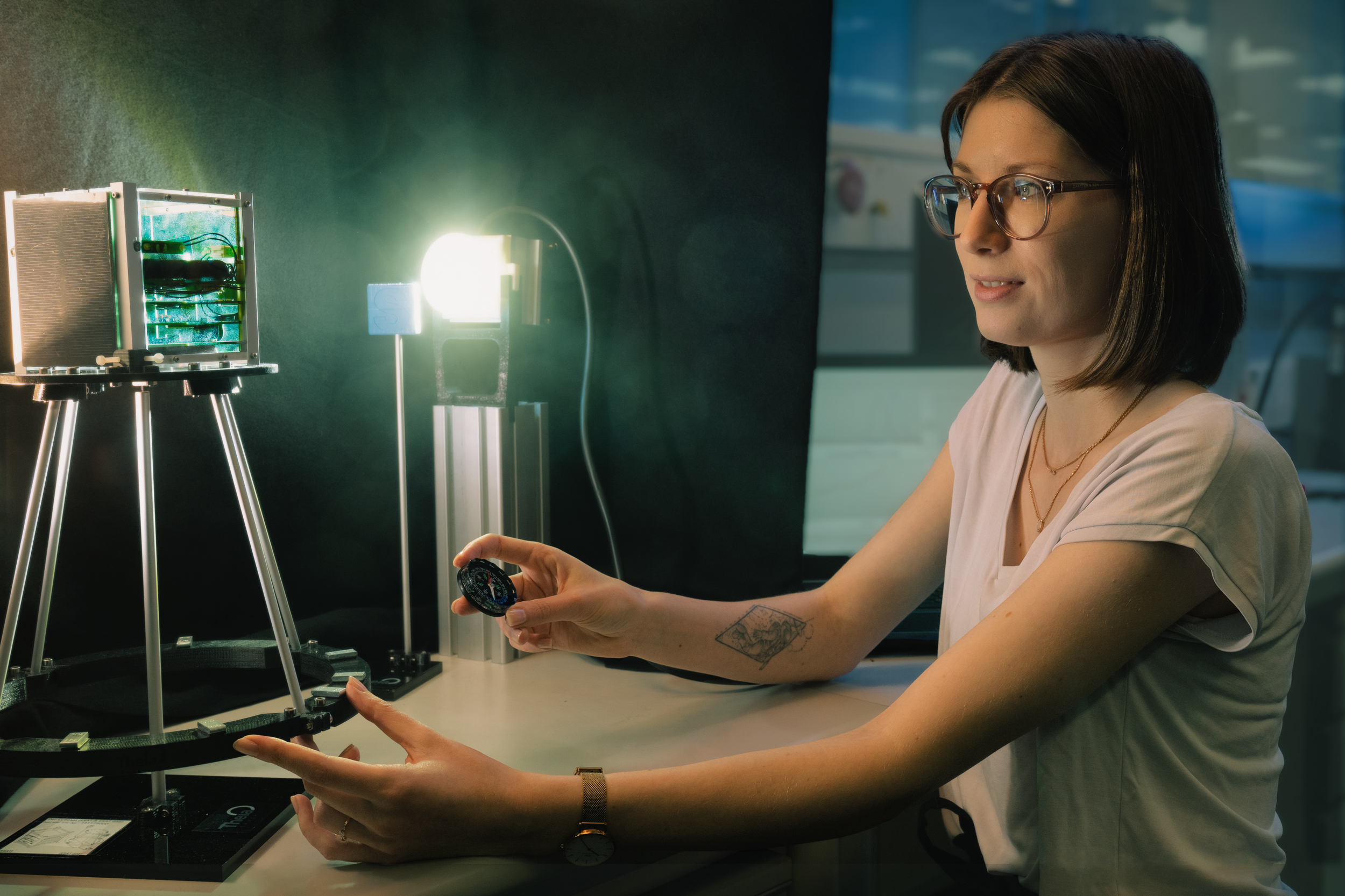
May 2022: Doctoral candidate Maren Hülsmann from the Faculty of Aerospace Engineering has been awarded the ZONTA International Amelia Earhart Fellowship for the academic year 2022–2023.
The Amelia Earhart Fellowship has been awarded since 1938 for research directly related to aeronautics and astronautics. Each year, only up to 35 outstanding women scientists worldwide in the field of aerospace receive this prestigious fellowship, worth 10,000 USD. This is already the seventh time that a researcher from the University of the Bundeswehr Munich has been honored with this award.
Her supervisor, Prof. Roger Förstner, Chair of Astronautics, is also delighted about the recognition for Maren Hülsmann:
“Maren Hülsmann is conducting research on an extremely important and timely topic, and she fully deserves this award. She is doing excellent work, is highly dedicated, and drives the field forward,” says Prof. Förstner.
He emphasizes: “The fact that several award recipients have come from the University of the Bundeswehr Munich shows that we consistently have excellent women in research and can continue to attract them.”
For her doctoral work on artificial intelligence for space applications, Maren Hülsmann had already received the Amelia Earhart Club Prize from the ZONTA Club Munich I in 2021.
Error Management in Space
After studying applied mathematics in Bremen, Maren Hülsmann chose a career in the space sector. She worked as a flight dynamics specialist at the German Aerospace Center (DLR) before joining the Institute of Astronautics and Space Utilization at the University of the Bundeswehr Munich for her doctoral studies. As part of her PhD in artificial intelligence (AI), she works on cutting-edge technologies used in satellite applications and spacecraft operations.
With future megaconstellations, low Earth orbit will become increasingly crowded, leading to more collisions and enormous amounts of orbital and telemetry data that must be monitored. As a result, there is a growing need for spacecraft capable of autonomously detecting and responding to hazardous events such as malfunctions and collisions in orbit.
Her dissertation focuses on AI-based fault management for multi-spacecraft systems, developing concepts for predicting, explaining, and recovering from dangerous events before they occur. The algorithms she develops will be tested on board the SeRANIS satellite, funded by dtec.bw, which is currently being developed at the University of the Bundeswehr and is scheduled for launch in early 2025.
A Pioneer of Aviation
The fellowship provides young women researchers with financial support to pursue their PhDs or further research. The Amelia Earhart Fellowships aim to eliminate the gender-based disadvantages faced by women in obtaining doctoral degrees in aerospace engineering and space sciences.
The fund was established in memory of aviation pioneer and ZONTA member Amelia Earhart, who disappeared in 1937 during the final leg of her attempt to fly around the world. Born on July 24, 1897, in Atchison, Kansas, Earhart was the first woman to fly solo across the Atlantic Ocean, to complete a transcontinental flight, and to receive the U.S. Distinguished Flying Cross.
You can read the original article here.